Showing posts with label AMD. Show all posts

Wednesday, August 11, 2010

VMware Management Assistant Panics on Magny Cours

VMware's current version of its vSphere Management Assistant - also known as vMA (pronounced "vee mah") - will crash when run on an ESX host using AMD Magny Cours processors. This behavior was discovered recently when installing the vMA on an AMD Opteron 6100 system (aka. Magny Cours) causing a "kernel panic" on boot after deploying the OVF template. Something of note is the crash also results in 100% vCPU utilization until the VM is either powered-off or reset:

[caption id="attachment_1624" align="aligncenter" width="436" caption="vMA Kernel Panic on Import"]vMA Kernel Panic on Import[/caption]

As it turns out, no manner of tweaks to the virtual machine's virtualization settings nor OS boot/grub settings (i.e. noapic, etc.) seem to cure the ills for vMA. However, we did discover that the OVF deployed appliance was configured as a VMware Virtual Machine Hardware Version 4 machine:

[caption id="attachment_1625" align="aligncenter" width="450" caption="vMA 4.1 defaults to Virtual Machine Hardware Version 4"]vMA 4.1 defaults to Hardware Version 4[/caption]

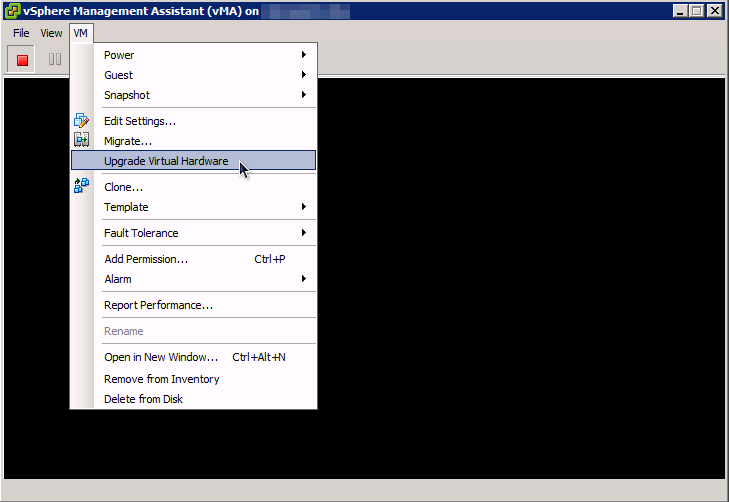
Since our lab vMA deployments have all been upgraded to Virtual Machine Harware Version 7 for some time (and for functional benefits as well), we tried to update the vMA to Version 7 and try again:

[caption id="attachment_1626" align="aligncenter" width="450" caption="Upgrade vMA Virtual Machine Version..."]Upgrade vMA Virtual Machine Version...[/caption]

This time, with Virtual Hardware Version 7 (and no other changes to the VM), the vMA boots as it should:

[caption id="attachment_1627" align="aligncenter" width="450" caption="vMA Booting after Upgrade to Virtual Hardware Version 7"]vMA Booting after Upgrade to Virtual Hardware Version 7[/caption]

Since the Magny Cours CPU is essentially a pair of tweaked 6-core Opteron CPUs in a single package, we took the vMA into the lab and deployed it to an ESX server running on AMD 2435 6-core CPUs: the vMA booted as expected, even with Virtual Hardware Version 4. A quick check of the community and support boards show a few issues with older RedHat/Centos kernels (like vMA's) but no reports of kernel panic with Magny Cours. Perhaps there are just not that many AMD Opteron 6100 deployments out there with vMA yet...

Friday, June 11, 2010

vSphere 4 Update 2 Released

VMware vSphere 4, Update 2 has been released with the following changes to ESXi:
The following information provides highlights of some of the enhancements available in this release of VMware ESXi:

  • Enablement of Fault Tolerance Functionality for Intel Xeon 56xx Series processors— vSphere 4.0 Update 1 supports the Intel Xeon 56xx Series processors without Fault Tolerance. vSphere 4.0 Update 2 enables Fault Tolerance functionality for the Intel Xeon 56xx Series processors.

  • Enablement of Fault Tolerance Functionality for Intel i3/i5 Clarkdale Series and Intel Xeon 34xx Clarkdale Series processors— vSphere 4.0 Update 1 supports the Intel i3/i5 Clarkdale Series and Intel Xeon 34xx Clarkdale Series processors without Fault Tolerance. vSphere 4.0 Update 2 enables Fault Tolerance functionality for the Intel i3/i5 Clarkdale Series and Intel Xeon 34xx Clarkdale Series processors.

  • Enablement of IOMMU Functionality for AMD Opteron 61xx and 41xx Series processors— vSphere 4.0 Update 1 supports the AMD Opteron 61xx and 41xx Series processors without input/output memory management unit (IOMMU). vSphere 4.0 Update 2 enables IOMMU functionality for the AMD Opteron 61xx and 41xx Series processors.

  • Enhancement of the resxtop utility— vSphere 4.0 U2 includes an enhancement of the performance monitoring utility, resxtop. The resxtop utility now provides visibility into the performance of NFS datastores in that it displays the following statistics for NFS datastores: Reads/s, writes/s, MBreads/s, MBwrtn/s, cmds/s, GAVG/s (guest latency).

  • Additional Guest Operating System Support— ESX/ESXi 4.0 Update 2 adds support for Ubuntu 10.04. For a complete list of supported guest operating systems with this release, see the VMware Compatibility Guide.


Resolved Issues – In addition, this release delivers a number of bug fixes that have been documented in theResolved Issues section.

ESXi 4 Update 2 Release Notes


Noted in the release is the official support for AMD's IOMMU in Opteron 6100 and 4100 processors - available in 1P, 2P and 4P configurations. This finally closes the (functional) gap between AMD Opteron and Intel's Nehalem line-up. Likewise, FT support for many new Intel processors has been added. Also, the addition of NFS performance counters in ESXTop will make storage troubleshooting a bit easier. Grab you applicable update at VMware's download site now (SnS required.)

Tuesday, March 2, 2010

Quick Take: Q1 DRAM Price Follow-up, 8GB DDR3 Below Target

In September 2009 we predicted that average 8GB DIMM prices (DDR2 and DDR3) would reach $565/stick by year end (with DDR3 being higher than DDR2) and at now we're seeing the reversal of fortunes for DDR2. At year end, the average price for benchmark DDR2/DDR3 was $591 retail, with promotional pricing pushing that below$550 as predicted. Today, we're seeing DDR3 begin to overtake DDR2 in the 8GB ECC category, dropping below $510/stick, while DDR2 climbs to $550/stick (promotional, on $625/stick retail.)

In 4GB ECC configurations, DDR2 enjoys only a slight retail advantage (13%) while promotional pricing (likely due to inventory reduction initiatives) are providing a bit better value short term. However, the price gap is only 1/2 the power gap, with DDR3 delivering a greater than 35% reduction in power over its DDR2 equivalent (about $1.25/year/stick at $0.10/kWh). The honeymoon is almost over for DDR2.


Benchmark Server (Spot) Memory Pricing - Dual Rank DDR2 Only
DDR2 Reg. ECC Series (1.8V)Price Jun '09Price Sep '09Price Dec '09Price Mar '10


KVR800D2D4P6/4G
4GB 800MHz DDR2 ECC Reg with Parity CL6 DIMM Dual Rank, x4
(5.400W operating)

$100.00$117.00
up 17%
$140.70
up 23% promo
$128.90

($151 retail)


KVR667D2D4P5/4G
4GB 667MHz DDR2 ECC Reg with Parity CL5 DIMM Dual Rank, x4 (5.940W operating)

$80.00$103.00
up 29%
$97.99
down 5%
$128.74

($149 retail)


KVR667D2D4P5/8G
8GB 667MHz DDR2 ECC Reg with Parity CL5 DIMM Dual Rank, x4 (7.236W operating)

$396.00$433.00$433.00 (promo)$550.00
(Promo price, retail $625)


Benchmark Server (Spot) Memory Pricing - Dual Rank DDR3 Only
DDR3 Reg. ECC Series (1.5V)Price Jun '09Price Sep '09Price Dec '09Price Mar '10


KVR1333D3D4R9S/4G
4GB 1333MHz DDR3 ECC Reg w/Parity CL9 DIMM Dual Rank, x4 w/Therm Sen (3.960W operating)

$138.00$151.00
up 10%
$135.99
down 10%

$150.74

($170 retail)


KVR1066D3D4R7S/4G
4GB 1066MHz DDR3 ECC Reg w/Parity CL7 DIMM Dual Rank, x4 w/Therm Sen (5.085W operating)

$132.00$151.00
up 15%
$137.59
down 9% (promo)
$150.74
($170 retail)


KVR1066D3D4R7S/8G
8GB 1066MHz DDR3 ECC Reg w/Parity CL7 DIMM Dual Rank, x4 w/Therm Sen (4.110W operating)

$1035.00$917.00 down 11.5%$667.00
down 28%
$506.59

(retail $584, avail. 3/15)


KVR1333D3D4R9S/8GHA
8GB 1333MHz DDR3 ECC Reg CL9 DIMM 2R x4 w/TS Server Hynix A (4.635W operating)

$584.00

SOLORI's Take: With strong DDR3 demand and short-falls in DDR2 supply (according to DRAMeXchange), the only thing keeping DDR3 prices above DDR2 at this point is demand and inventory. As Q2/2010 introduces a rush of new workstation and server products based on DDR3 systems, the DRAM production ramp will eventually stabilize demand somewhere towards the end of Q3/2010. Meanwhile, technology companies like VMware, Microsoft, Intel and AMD are betting on new infrastructure spending on operating systems, virtualization and hardware refresh to drive-up economic market factors. If the global economic crisis deepens, this anticipated spending spree could be short-lived and its impact shallow.

Quick-Take: AMD Dodeca-core Opteron, Real Soon Now

In a recent blog, John Fruehe recounted a few highlights from the recent server analyst event at AMD/Austin concerning the upcoming release of AMD's new 12-core (dodeca) Opteron 6100 series processor - previously knows as Magny-Cours. While not much "new" was officially said outside of NDA privilege, here's what we're reading from his post:

1. Unlike previous launches, AMD is planning to have "boots on the ground" this time with vendors and supply alignments in place to be able to ship product against anticipated demand. While it is now well known that Magny-Cours has been shipping to certain OEM and institutional customers for some time, our guess is that 2000/8000 series 6-core HE series have been hard to come by for a reason - and that reason has 12-cores not 6;
Obviously the big topic was the new AMD Opteron™ 6000 Series platforms that will be launching very soon.  We had plenty of party favors – everyone walked home with a new 12-core AMD Opteron 6100 Series processor, code name “Magny-Cours”.

- Fruehe on AMD's pending launch


2. Timing is right! With Intel's Nehalem-EX 8-core and Core i7/Nehalem-EP 6-core being demoed about, there is more pressure than ever for AMD to step-up with a competitive player. Likewise, DDR3 is neck-and-neck with DDR2 in affordability and way ahead with low-power variants that more than compensate for power-hungry CPU profiles. AMD needs to deliver mainstream performance in 24-cores and 96GB DRAM within the power envelope of 12-cores and 64GB to be a player. With 1.35V DDR3 parts paired to better power efficiency in the 6100, this could be a possibility;
We demonstrated a benchmark running on two servers, one based on the Six-Core AMD Opteron processor codenamed “Istanbul,” and one 12-core “Magny-Cours”-based platform.  You would have seen that the power consumption for the two is about the same at each utilization level.  However, there is one area where there was a big difference – at idle.  The “Magny-Cours”-based platform was actually lower!

- AMD's Fruehe on Opteron 6100's power consumption


3. Performance in scaled virtualization matters - raw single-threaded performance is secondary. In virtual architectures, clusters of systems must perform as one in an orchestrated ballet of performance and efficiency seeking. For some clusters, dynamic load migration to favour power consumption is a priority - relying on solid power efficiency under high load conditions. For other clusters, workload is spread to maximize performance available to key workloads - relying on solid power efficiency under generally light loads. For many environments, multi-generational hardware will be commonplace and AMD is counting on its wider range of migration compatibility to hold-on to customers that have not yet jumped ship for Intel's Nehalem-EP/EX.
"We demonstrated Microsoft Hyper-V running on two different servers, one based on a Quad-Core AMD Opteron processor codenamed “Barcelona” (circa 2007) and a brand new “Magny-Cours”-based system. ...companies might have problems moving a 2010 VM to a 2007 server without limiting the VM features. (For example, in order to move a virtual machine from an Intel  “Nehalem”-based system to a “Harpertown” [or earlier] platform, the customer must not enable nested paging in the “Nehalem” virtual machine, which can reduce the overall performance of the VM.)"

- AMD's Fruehe, extolling the virtues of Opteron generational compatibility


SOLORI's Take: It would appear that Magny-Cours has more under the MCM hood than a pair of Istanbul processors (as previously charged.) To manage better idle performance and constant power performance in spite of a two-to-one core ratio and similar 45nm process, AMD's process and feature set must include much better power management as well, however, core speed is not one of them. With the standard "Maranello" 6100 series coming in at 1.9, 2.1 and 2.2 GHz with an HE variant at 1.7GHz and SE version running at 2.3GHz, finding parity in an existing cluster of 2.4, 2.6 and 2.8 GHz six-core servers may be difficult. Still, Maranello/G34 CPUs will be at 85, 115 and 140W TDP.

That said, Fruehe has a point on virtualization platform deployment and processor speed: it is not necessary to trim-out an entire farm with top-bin parts - only a small portion of the cluster needs to operate with top-band performance marks. The rest of the market is looking for predictable performance, scalability and power efficiency per thread. While SMT makes a good run at efficiency per thread, it does so at the expense of predictable performance. Here's hoping that AMD's C1E (or whatever their power-sipping special sauce will be called) does nothing to interfere with predictable performance...

As we've said before, memory capacity and bandwidth (as a function of system power and core/thread capacity) are key factors in a CPU's viability in a virtualization stack. With 12 DIMM slots per CPU (3-DPC, 4-channel), AMD inherits an enviable position over Intel's current line-up of 2P solutions by being able to offer 50% more memory per cluster node without resorting to 8GB DIMMs. That said, it's up to OEM's to deliver rack server designs that feature 12 DIMM per CPU and not hold-back with only 8 DIMM variants. In the blade and 1/2-size market, cramming 8 DIMM per board (effectively 1-DPC for 2P Magny-Cours) can be a challenge let alone 24 DIMMs! Perhaps we'll see single-socket blades with 12 DIMMs (12-cores, 48/96GB DDR3) or 2P blades with only one 12 DIMM memory bank (one-hop, NUMA) in the short term.

SOLORI's 2nd Take: It makes sense that AMD would showcase their leading OEM partners because their success will be determined on what those OEM's bring to market. With VDI finally poised to make a big market impact, we'd expect to see the first systems delivered with 2-DPC configurations (8 DIMM per CPU, economically 2.5GB/core) which could meet both VDI and HPC segments equally. However, with Window7 gaining momentum, what's good for HPC might not cut it for long in the VDI segment where expectations of 4-6 VM's per core at 1-2GB/VM are mounting.

Besides the launch date, what wasn't said was who these OEM's are and how many systems they'll be delivering at launch. Whoever they are, they need to be (1) financially stronger than AMD, (2) in an aggressive marketing position with respect to today's key growth market (server and desktop virtualization), and (3) willing to put AMD-based products "above the fold" on their marketing and e-commerce initiatives. AMD needs to "represent" in a big way before a tide of new technologies makes them yesterday's news. We have high hopes that AMD's recent "perfect" execution streak will continue.

Thursday, November 19, 2009

NEC Offers "Dunnington" Liposuction, Tops 64-Core VMmark

NEC’s venerable Express5800/A1160 is back at the top VMmark chart, this time establishing the brand-new 64-core category with a score of 48.23@32 tiles - surpassing its 48-core 3rd place posting by over 30%. NEC’s new 16-socket, 64-core, 256GB “Dunnington” X7460 Xeon-based score represents a big jump in performance over its predecessor with a per tile ratio of 1.507 - up 6% from the 48-core ratio of 1.419.


To put this into perspective, the highest VMmark achieved, to date, is the score of 53.73@35 tiles (tile ratio 1.535) from the 48-core HP DL785 G6 in August, 2009. If you are familiar with the "Dunnington" X7460, you know that it's a 6-core, 130W giant with 16MB L2 cache and a 1000's price just south of $3,000 per socket. So that raises the question: how does 6-cores X 16-sockets = 64? Well, it's not pro-rationing from the Obama administration's "IT fairness" czar. NEC chose to disable the 4th and 6th core of each socket to reduce the working cores from 96 to 64.


At $500/core, NEC's gambit may represent an expensive form of "core liposuction" but it was a necessary one to meet VMware's "logical processor per host" limitation of 64. That's right, currently VMware's vSphere places a limit on logical processors based on the following formula:


CPU_Sockets X Cores_Per_Socket X Threads_Per_Core =< 64


According to VMware, the other 32 cores would have been "ignored" by vSphere had they been enabled. Since "ignored" is a nebulous term (aka "undefined"), NEC did the "scientific" thing by disabling 32 cores and calling the system a 64-core server. The win here: a net 6% improvement in performance per tile over the 6-core configuration - ostensibly from the reduced core loading on the 16MB of L3 cache per socket and reduction in memory bus contention.


Moving forward to 2010, what does this mean for vSphere hardware configurations in the wake of 8-core, 16-thread Intel Nehalem-EX and 12-core, 12-thread AMD Magny-Cours processors? With a 4-socket Magny-Cours system limitation, we won't be seeing any VMmarks from the boys in green beyond 48-cores. Likewise, the boys in blue will be trapped by a VMware limitation (albeit, a somewhat arbitrary and artificial one) into a 4-socket, 64-thread (HT) configuration or an 8-socket, 64-core (HT-disabled) configuration for their Nehalem-EX platform - even if using the six-core variant of EX. Looks like VMware will need to lift the 64-LCPU embargo by Q2/2010 just to keep up.

Friday, October 9, 2009

Quick Take: Red Hat and Microsoft Virtual Inter-Op

This week Red Hat and Microsoft announced support of certain of their OSes as guests in their respective hypervisor implementations: Kernel Virtual Machine (KVM) and Hyper-V, respectively. This comes on the heels of Red Hat's Enterprise Server 5.4 announcement last month.

KVM is Red Hat's new hypervisor that leverages the Linux kernel to accelerate support for hardware and capabilities. It was Red Hat and AMD that first demonstrated live migration between AMD and Intel-based hypervisors using KVM late last year - then somewhat of a "Holy Grail" of hypervisor feats. With nearly a year of improvements and integration into their Red Hat Enterprise Server and Fedora "free and open source" offerings, Red Hat is almost ready to strike-out in a commercially viable way.

Microsoft now officially supports the following Red Hat guest operating systems in Hyper-V:

Red Hat Enterprise Linux 5.2, 5.3 and 5.4


Red Hat likewise officially supports the following Microsoft quest operating systems in KVM:

Windows Server 2003, 2008 and 2008 R2


The goal of the announcement and associated agreements between Red Hat and Microsoft was to enable a fully supported virtualization infrastructure for enterprises with Red Hat and Microsoft assets. As such, Microsoft and Red Hat are committed to supporting their respective products whether the hypervisor environment is all Red Hat, all Hyper-V or totally heterogeneous - mixing Red Hat KVM and Microsoft Hyper-V as necessary.
"With this announcement, Red Hat and Microsoft are ensuring their customers can resolve any issues related to Microsoft Windows on Red Hat Enterprise Virtualization, and Red Hat Enterprise Linux operating on Microsoft Hyper-V, regardless of whether the problem is related to the operating system or the virtualization implementation."

- Red Hat press release, October 7, 2009


Many in the industry cite Red Hat's adoption of KVM as a step backwards [from Xen] requiring the re-development of significant amount of support code. However, Red Hat's use of libvirt as a common management API has allowed the change to happen much more rapidly that critics assumptions had allowed. At Red Hat Summit 2009, key Red Hat officials were keen to point out just how tasty their "dog food" is:
Tim Burke, Red Hat's vice president of engineering, said that Red Hat already runs much of its own infrastructure, including mail servers and file servers, on KVM, and is working hard to promote KVM with key original equipment manufacturer partners and vendors.

And Red Hat CTO Brian Stevens pointed out in his Summit keynote that with KVM inside the Linux kernel, Red Hat customers will no longer have to choose which applications to virtualize; virtualization will be everywhere and the tools to manage applications will be the same as those used to manage virtualized guests.

- Xen vs. KVM, by Pam Derringer, SearchDataCenter.com


For system integrators and virtual infrastructure practices, Red Hat's play is creating opportunities for differentiation. With a focus on light-weight, high-performance, I/O-driven virtualization applications and no need to support years-old established processes that are dragging on Xen and VMware, KVM stands to leap-frog the competition in the short term.

SOLORI's Take: This news is good for all Red Hat and Microsoft customers alike. Indeed, it shows that Microsoft realizes that its licenses are being sold into the enterprise whether or not they run on physical hardware. With 20+:1 consolidation ratios now common, that represents a 5:1 license to hardware sale for Microsoft, regardless of the hypervisor. With KVM's demonstrated CPU agnostic migration capabilities, this opens the door to an even more diverse virtualization infrastructure than ever before.

On the Red Hat side, it demonstrates how rapidly Red Hat has matured its offering following the shift to KVM earlier this year. While KVM is new to Red Hat, it is not new to Linux or aggressive early adopters since being added to the Linux kernel as of 2.6.20 back in September of 2007. With support already in active projects like ConVirt (VM life cycle management), OpenNebula (cloud administration tools), Ganeti, and Enomaly's Elastic Computing Platform, the game of catch-up for Red Hat and KVM is very likely to be a short one.

Wednesday, October 7, 2009

Quick Take: Nehalem/Istanbul Comparison at AnandTech

Johan De Gelas and crew present an interesting comparison of Dunnington, Shanghai, Istanbul and Nehalem in a new post at AnandTech this week. In the test line-up are the "top bin" parts from Intel and AMD in 4-core and 6-core incarnations:

  • Intel Nehalem-EP Xeon, X5570 2.93GHz, 4-core, 8-thread

  • Intel "Dunnington" Xeon, X7460, 2.66GHz, 6-core, 6-thread

  • AMD "Shanghai" Opteron 2389/8389, 2.9GHz, 4-core, 4-thread

  • AMD "Istanbul" Opteron 2435/8435, 2.6GHz, 6-core, 6-thread


Most importantly for virtualization systems architects is how the vCPU scheduling affects "measured" performance. The telling piece comes from the difference in comparison results where vCPU scheduling is equalized:

[caption id="attachment_1276" align="aligncenter" width="450" caption="AnandTech's Quad Sockets v. Dual Sockets Comparison. Oct 6, 2009."]AnandTech's Quad Sockets v. Dual Sockets Comparison. Oct 6,  2009.[/caption]

When comparing the results, De Gelas hits on the I/O factor which chiefly separates VMmark from vAPUS:
The result is that VMmark with its huge number of VMs per server (up to 102 VMs!) places a lot of stress on the I/O systems. The reason for the Intel Xeon X5570's crushing VMmark results cannot be explained by the processor architecture alone. One possible explanation may be that the VMDq (multiple queues and offloading of the virtual switch to the hardware) implementation of the Intel NICs is better than the Broadcom NICs that are typically found in the AMD based servers.

Johan De Gelas, AnandTech, Oct 2009


This is yet another issue that VMware architects struggle with in complex deployments. The latency in "Dunnington" is a huge contributor to its downfall and why the Penryn architecture was a dead-end. Combined with 8 additional threads in the 2P form factor, Nehalem delivers twice the number of hardware execution contexts than Shanghai, resulting in significant efficiencies for Nehalem where small working data sets are involved.

When larger sets are used - as in vAPUS - the Istanbul's additional cores allows it to close the gap to within the clock speed difference of Nehalem (about 12%). In contrast to VMmark which implies a 3:2 advantage to Nehalem, the vAPUS results suggest a closer performance gap in more aggressive virtualization use cases.

SOLORI's Take: We differ with De Gelas on the reduction in vAPUS' data set to accommodate the "cheaper" memory build of the Nehalem system. While this offers some advantages in testing, it also diminishes one of Opteron's greatest strengths: access to cheap and abundant memory. Here we have the testing conundrum: fit the test around the competitors or the competitors around the test. The former approach presents a bias on the "pure performance" aspect of the competitors, while the latter is more typical of use-case testing.

We do not construe this issue as intentional bias on AnandTech's part, however it is another vector to consider in the evaluation of the results. De Gelas delivers a report worth reading in its entirety, and we view this as a primer to the issues that will define the first half of 2010.

Monday, September 21, 2009

AMD Chipsets Launched: Fiorano and Kroner Platforms to Follow

The Channel Register is reporting on the launch of AMD's motherboard chipsets which will drive new socket-F based Fiorano and Kroner platforms as well as the socket G34 and C32 based Maranello and San Marino platforms. The Register also points out that no tier one PC maker is announcing socket-F solutions based on the new chipsets today. However, motherboard and "barebones" maker Supermicro is also announcing new A+ server, blade and workstation variants using the new AMD SR5690 and SP5100 chipsets, enabling:

  • GPU-optimized designs: Support up to four double-width GPUs along with two CPUs and up to 3 additional high-performance add-on cards.

  • Up to 10 quad-processor (MP) or dual-processor (DP) Blades in a 7U enclosure: Industry-leading density and power efficiency with up to 240 processor cores and 640GB memory per 7U enclosure.

  • 6Gb/s SAS 2.0 designs: Four-socket and two-socket server and workstation solutions with double the data throughput of previous generation storage architectures.

  • Universal I/O designs: Provide flexible I/O customization and investment protection.

  • QDR InfiniBand support option: Integrated QDR IB switch and UIO add-on card solution for maximum I/O performance.

  • High memory capacity: 16 DIMM models with high capacity memory support to dramatically improve memory and virtualization performance.

  • PCI-E 2.0 Slots plus Dual HT Links (HT3) to CPUs: Enhance motherboard I/O bandwidth and performance. Optimal for QDR IB card support.

  • Onboard IPMI 2.0 support: Reduces remote management costs.


Eco-Systems based on Supermicro's venerable AS2021M - based on the NVidia nForce Pro 3600 chipset - can now be augmented with the Supermicro AS2021A variant based on AMD's SR5690/SP5100 pairing. Besides offering HT3.0 and on-board Winbond WPCM450 KVM/IP BMC module, the new iteration includes support for the SR5690's IOMMU function (experimentally supported by VMware), 16 DDR2 800/667/533 DIMMs, and four PCI-E 2.0 slots - all in the same, familiar 2U chassis with eight 3.5" hot-swap bays.

AMD's John Fruehe outlines AMD's market approach for the new chipsets in his "AMD at Work" blog today. Based on the same basic logic/silicon, the SR5690, SR5670 and SR5650 all deliver PCI-E 2.0 and HT3.0 but at differing levels of power consumption and PCI Express lanes to their respective platforms. Paired with appropriate "power and speed" Opteron variant, these platforms offer system designers, virtualization architects and HPC vendors greater control over price-performance and power-performance constraints that drive their respective environments.

AMD chose the occasion of the Embedded Systems Conference in Boston to announce its new chipset to the world. Citing performance-per-watt advantages that could enhance embedded systems in the telecom, storage and security markets, AMD's press release highlighted three separate vendors with products ready to ship based on the new AMD chipsets.

Monday, September 14, 2009

Quick Take: DRAM Price Follow-Up

As anticipated, global DRAM prices have continued their upward trend through September, 2009. We reported on August 4, 2009 about the DDR3 and DDR2 price increases that - coupled with a short-fall in DDR3 production - have caused a temporary shift of the consumer market towards DDR2-based designs.

Last week, the Inquirer also reported that DRAM prices were on the rise and that the trend will result in parity between DDR2 and DDR3 prices. MaximumPC ran the Inquirer's story urging its readers to buy now as the tide rises on both fronts. DRAMeXchange is reporting a significant revenue gain to the major players in the DRAM market as a result of this well orchestrated ballet of supply and demand. The net result for consumers is higher prices across the board as the DDR2/DDR3 production cross-over point is reached.

2Q2009-WW-DRAM-revenue


SOLORI's Take: DDR2 is a fading bargain in the server markets, and DIMM vendors like Kingston are working to maintain a stable source of DDR2 components through the end of 2009. While still Looking at our benchmark tracking components, we project 8GB DIMMs to average $565/DIMM by the end of 2009. In the new year, expect 8GB/DDR2 to hit $600/DIMM by the end of H2/2010 with lower pricing on 8GB/DDR3-1066 - in the $500/DIMM range (if supply can keep up with new system demands created by continued growth in the virtualization market.)


Benchmark Server Memory Pricing
DDR2 Series (1.8V)Price Jun '09Price Sep '09DDR3 Series (1.5V)Price Jun '09Price Sep '09


4GB 800MHz DDR2 ECC Reg with Parity CL6 DIMM Dual Rank, x4 (5.4W)

$100.00$117.00

up 17%


4GB 1333MHz DDR3 ECC Reg w/Parity CL9 DIMM Dual Rank, x4 w/Therm Sen (3.96W)

$138.00
$151.00


up 10%


4GB 667MHz DDR2 ECC Reg with Parity CL5 DIMM Dual Rank, x4 (5.94W)

$80.00$103.00

up 29%


4GB 1066MHz DDR3 ECC Reg w/Parity CL7 DIMM Dual Rank, x4 w/Therm Sen (5.09W)

$132.00$151.00

up 15%


8GB 667MHz DDR2 ECC Reg with Parity CL5 DIMM Dual Rank, x4 (7.236W)

$396.00$433.00

up 9%


8GB 1066MHz DDR3 ECC Reg w/Parity CL7 DIMM Dual Rank, x4 w/Therm Sen (6.36W)

$1035.00$917.00

down 11.5%

SOLORI's 2nd Take: Samsung has been driving the DRAM roller coaster in an effort to dominate the market. With Samsung's 40-nm 2Gb DRAM production ramping by year end, the chip maker's infulence could create a disruptive position in the PC and server markets by driving 8GB/DDR3 prices into the sub-$250/DIMM range by 2H/2010. Meanwhile Hynix, the #2 market leader, chases with 40-nm 1Gb DDR3 giving Samsung the opportunity to repeat its 2008/2009 gambit in 2010 making it increasingly harder for competitors to get a foot-hold in the DDR3 market.

Samsung has their eye on the future with 16GB and 32GB DIMMs already exhibited with 50-nm 2Gb parts claiming a 20% power savings over the current line of memory. With 40-nm 2Gb parts, Samsung is claiming up to 30% additional power savings. To put this into perspective, eight 32GB DIMMs would could about 60% of the power consumed by 32 8GB DIMMs (requiring a 4P+ server). In a virtualization context, this is enough memory to enable 100 virtual machines with 2.5GB of memory each without over subscription. Realistically, we expect to see 16GB DDR3 DIMMs at $1,200/DIMM by 2H/2010 - if everything goes according to plan.

Sunday, September 13, 2009

Quick Take: Magny-Cours Spotted, Pushed to 3GHz for wPrime

Andreas Galistel at NordicHardware posted an article showing a system running a pair of engineering samples of the Magny-Cours processor running at 3.0GHz. Undoubtedly these images were culled from a report "leaked" on XtremeSystems forums showing a "DINAR2" motherboard with SR5690 chipset - in single and dual processor installation - running Magny-Cours at the more typical pre-release speed of 1.7GHz.

We know that Magny-Cours is essentially a MCM of Istanbul delivered in the rectangular socket G34 package. One thing illuminating about the two posts is the reported "reduction" in L3 cache from 12MB (6MB x 2 in MCM) to 10MB (2 x 5MB in MCM). Where did the additional cache go? That 's easy: since a 2P Magny-Cours installation is essentially a 4P Istanbul configuration, these processors have the new HT Assist feature enabled - giving 1MB of cache from each chip in the MCM to HT Assist.
"wPrime uses a recursive call of Newton's method for estimating functions, with f(x)=x2-k, where k is the number we're sqrting, until Sgn(f(x)/f'(x)) does not equal that of the previous iteration, starting with an estimation of k/2. It then uses an iterative calling of the estimation method a set amount of times to increase the accuracy of the results. It then confirms that n(k)2=k to ensure the calculation was correct. It repeats this for all numbers from 1 to the requested maximum."

- wPrime site


Another thing intriguing about the XtremeSystems post in particular is the reported wPrime 32M and 1024M completion times. Compared to the hyper-threading-enabled 2P Xeon W5590 (130W TDP) running wPrime 32M at 3.33GHz (3.6GHz turbo)  in 3.950 seconds, the 2P 3.0GHz Magny-Cours completed wPrime 32M in an unofficial 3.539 seconds - about 10% quicker while running a 10% slower clock. From the myopic lens of this result, it would appear AMD's choice of "real cores" versus hyper-threading delivers its punch.

SOLORI's Take: As a "reality check" we can compared the reigning quad-socked, quad-core Opteron 8393 SE result in wPrime 32M and wPrime 1024M at 3.90 and 89.52  seconds, respectively. Adjusted for clock and core count versus its Shanghai cousin, the Magny-Cours engineering samples - at 3.54 and 75.77 seconds, respectively - turned-in times about 10% slower than our calculus predicted. While still "record breaking" for 2P systems, we expected the Magny-Cours/Istanbul cores to out-perform Shanghai clock-per-clock - even at this stage of the game.

Due to the multi-threaded nature of the wPrime benchmark, it is likely that the HT Assist feature - enabled in a 2P Magny-Cours system by default - is the cause of the discrepancy. By reducing the available L3 cache by 1MB per die - 4MB of L3 cache total - HT Assist actually could be creating a slow-down. However, there are several things to remember here:

  • These are engineering samples qualified for 1.7GHz operation

  • Speed enhancements were performed with tools not yet adapted to Magny-Cours

  • The author indicated a lack of control over AMD's Cool 'n Quiet technology which could have made "as tested" core clocks somewhat lower than what CPUz reported (at least during the extended tests)

  • It is speculated that AMD will release Magny-Cours at 2.2GHz (top bin) upon release, making the 2.6+ GHz results non-typical

  • The BIOS and related dependencies are likely still being "baked"


Looking at the more "typical" engineering sample speed tests posted on the XtremeSystems' forum tracks with the 3.0GHz overclock results at a more "typical" clock speed of 2.6GHz for 2P Magny-Cours: 3.947 seconds and 79.625 seconds for wPrime 32M and 1024M, respectively. Even at that speed, the 24-core system is on par with the 2P Nehalem system clocked nearly a GHz faster. Oddly, Intel reports the W5590  as not supporting "turbo" or hyper-threading although it is clear that Intel's marketing is incorrect based on actual testing.

Assuming Magny-Cours improves slightly on its way to market, we already know how 24-core Istanbul stacks-up against 16-thread Nehalem in VMmark and what that means for Nehalem-EP. This partly explains the marketing shift as Intel tries to position Nehalep-EP as a destined for workstations instead of servers. Whether or not you consider this move a prelude to the ensuing Nehalem-EX v. Magny-Cours combat to come or an attempt to keep Intel's server chip power average down by eliminating the 130W+ parts from the "server" list,  Intel and AMD will each attempt win the war before the first shot is fired. Either way, we see nothing that disrupts the price-performance and power-performance comparison models that dominate the server markets.

[Ed: The 10% difference is likely due to the fact that the author was unable to get "more than one core" clocked at 3.0GHz. Likewise, he was uncertain that all cores were reliably clocking at 2.6GHz for the longer wPrime tests. Again, this engineering sample was designed to run at 1.7GHz and was not likely "hand picked" to run at much higher clocks. He speculated that some form of dynamic core clocking linked to temperature was affecting clock stability - perhaps due to some AMD-P tweaks in Magny-Cours.]

Wednesday, September 9, 2009

Quick Take: Dell/Nehalem Take #2, 2P VMmark Spot


The new 1st runner-up spot for VMmark in the “8 core” category was taken yesterday by Dell's R710 - just edging-out the previous second spot HP ProLiant BL490 G6 by 0.1% - a virtual dead heat. Equipped with a pair of Xeon X5570 ($1386/ea, bulk list) and 96GB registered DDR3/1066 (12x8GB), the 2U, rack mount R710 weighs-in with a tile ratio of 1.43 over 102 VMs. :

  • Dell R710 w/redundant high-output power supply, ($18,209)

  • 2 x Intel Xeon X5570 Processors (included)

  • 96GB ECC DDR3/1066 (12×8GB) (included)

  • 2 x Broadcom NexXtreme II 5709 dual-port GigabitEthernet w/TOE (included)

  • 1 x Intel PRO 1000VT quad-port GigabitEthernet (1x PCIe-x4 slot, $529)

  • 3 x QLogic QLE2462 FC HBA (1x PCIe slot, $1,219/ea)

  • 1 x LSI1078 SAS Controller (on-board)

  • 8 x 15K SAS OS drive, RAID10 (included)

  • Required ProSupport package ($2,164)

  • Total as Configured: $24,559 ($241/VM, not including storage)


Three Dell/EMC CX3-40f arrays were used as the storage backing of the test. The storage system included 8GB cache, 2 enclosures and 15, 15K disks per array delivering 19 LUNs at about 300GB each. Intel's Hyper-Threading and  "Turbo Boost" were enabled for 8-thread, 3.33GHz core clocking as was VT; however embedded SATA and USB were disabled as is common practice.

At about $1,445/tile ($241/VM) the new “second dog” delivers its best at a 20% price premium over Lenovo's "top dog" - although the non-standard OS drive configuration makes-up a half of the difference, with Dell's mandatory support package making-up the remainder. Using a simple RAID1 SAS and eliminating the support package would have droped the cost to $20,421 - a dead heat with Lenovo at $182/VM.

Comparing the Dell R710 the 2P, 12-core benchmark HP DL385 G6 Istanbul system at 15.54@11 tiles:

  • HP DL385 G6  ($5,840)

  • 2 x AMD 2435 Istanbul Processors (included)

  • 64GB ECC DDR2/667 (8×8GB) ($433/DIMM)

  • 2 x Broadcom 5709 dual-port GigabitEthernet (on-board)

  • 1 x Intel 82571EB dual-port GigabitEthernet (1x PCIe slot, $150/ea)

  • 1 x QLogic QLE2462 FC HBA (1x PCIe slot, $1,219/ea)

  • 1 x HP SAS Controller (on-board)

  • 2 x SAS OS drive (included)

  • $10,673/system total (versus $14,696 complete from HP)


Direct pricing shows Istanbul’s numbers at $1,336/tile ($223/VM) which is  a 7.5% savings per-VM over the Dell R710. Going to the street - for memory only - changes the Istanbul picture to $970/tile ($162/VM) representing a 33% savings over the R710.

SOLORI's Take: Istanbul continues to offer a 20-30% CAPEX value proposition against Nehalem in the virtualization use case - even without IOMMU and higher memory bandwidth promised in upcoming Magny-Cours. With the HE parts running around $500 per processor, the OPEX benefits are there for Istanbul too. It is difficult to understand why HP wants to charge $900/DIMM for 8GB PC-5300 sticks when they are available on the street for 50% less - that's a 100% markup. Looking at what HP charges for 8GB DDR3/1066 - $1,700/DIM - they are at least consistent. HP's memory pricing practice makes one thing clear - customers are not buying large memory configurations from their system vendors...

On the contrary, Dell appears to be happy to offer decent prices on 8GB DDR3/1066 with their R710 at approximately $837/DIMM - almost par with street prices.  Looking to see if this parity held up with Dell's AMD offerings, we examined the prices offered with Dell's R805: while - at $680/DIMM - Dell's prices were significantly better than HP's, they still exceeded the market by 50%. Still, we were able to configure a Dell R805 with AMD 2435's for much less than the equivalent HP system:

  • Dell R805 w/redundant power ($7,214)

  • 2 x AMD 2435 Istanbul Processors (included)

  • 64GB ECC DDR2/667 (8×8GB) ($433/ea, street)

  • 4 x Broadcom 5708 GigabitEthernet (on-board)

  • 1 x Intel PRO 100oPT dual-port GigabitEthernet (1x PCIe slot, included)

  • 1 x QLogic QLE2462 FC HBA (1x PCIe slot, included)

  • 1 x Dell PERC SAS Controller (on-board)

  • 2 x SAS OS drive (included)

  • $10,678/system total (versus $12,702 complete from Dell)


This offering from Dell should be able to deliver equivalent performance with HP's DL385 G6 and likewise savings/VM compared to the Nehalem-based R710. Even at the $12,702 price as delivered from Dell, the R805 represents a potential $192/VM price point - about $50/VM (25%) savings over the R710.

Wednesday, August 26, 2009

Quick Take: HP's Sets Another 48-core VMmark Milestone

Not satisfied with a landmark VMmark score that crossed the 30 tile mark for the first time, HP's performance team went back to the benches two weeks later and took another swing at the performance crown. Well, the effort paid off, and HP significantly out-paced their two-week-old record with a score of 53.73@35 tiles in the heavy weight, 48-core category.

Using the same 8-processor HP ProLiant DL785 G6 platform as in the previous run - complete with 2.8GHz AMD Opteron 8439 SE 6-core chips and 256GB DDR2/667 - the new score comes with significant performance bumps in the javaserver, mailserver and database results achieved by the same system configuration as the previous attempt - including the same ESX 4.0 version (164009). So what changed to add an additional 5 tiles to the team's run? It would appear that someone was unsatisfied with the storage configuration on the mailserver run.

Given that the tile ratio of the previous run ran about 6% higher than its 24-core counterpart, there may have been a small indication that untapped capacity was available. According to the run notes, the only reported changes to the test configuration - aside from the addition of the 5 LUNs and 5 clients needed to support the 5 additional tiles - was a notation indicating that the "data drive and backup drive for all mailserver VMs" we repartitioned using AutoPart v1.6.

The change in performance numbers effectively reduces the virtualization cost of the system by 15% to about $257/VM - closing-in on its 24-core sibling to within $10/VM and stretching-out its lead over "Dunnington" rivals to about $85/VM. While virtualization is not the primary application for 8P systems, this demonstrates that 48-core virtualization is definitely viable.

SOLORI's Take: HP's performance team has done a great job tuning its flagship AMD platform, demonstrating that platform performance is not just related to hertz or core-count but requires balanced tuning and performance all around. This improvement in system tuning demonstrates an 18% increase in incremental scalability - approaching within 3% of the 12-core to 24-core scaling factor, making it actually a viable consideration in the virtualization use case.

In recent discussions with AMD about the SR5690 chipset applications for Socket-F, AMD re-iterated that the mainstream focus for SR5690 has been Magny-Cours and the Q1/2010 launch. Given the close relationship between Istanbul and Magny-Cours - detailed nicely by Charlie Demerjian at Semi-Accurate - the bar is clearly fixed for 2P and 4P virtualization systems designed around these chips. Extrapolating from the similarities and improvements to I/O and memory bandwidth, we expect to  see 2P VMmarks besting 32@23 and 4P scores over 54@39 from HP, AMD and Magny-Cours.

SOLORI's 2nd Take: Intel has been plugging away with its Nehalem-EX for 8-way systems and - delivering 128-threads - promises to deliver some insane VMmarks. Assuming Intel's EX scales as efficiently as AMD's new Opterons have, extrapolations indicate performance for the 4P, 64-thread Nehalem-EX shoud fall between 41@29 and 44@31 given the current crop of speed and performance bins. Using the same methods, our calculus predicts an 8P, 128-thread EX system should deliver scores between 64@45 and 74@52.

With EX expected to clock at 2.66GHz with 140W TDP and AMD's MCM-based Magny-Cours doing well to hit 130W ACP in the same speed bins, CIO's balancing power and performance considerations will need to break-out the spreadsheets to determine the winners here. With both systems running 4-channel DDR3, there will be no power or price advantage given on either side to memory differences: relative price-performance and power consumption of the CPU's will be major factors. Assuming our extrapolations are correct, we're looking at a slight edge to AMD in performance-per-watt in the 2P segment, and a significant advantage in the 4P segment.

Wednesday, August 12, 2009

Quick Take: HP Plants the Flag with 48-core VMmark Milestones

Following on the heels of last month we predicted that HP could easily claim the VMmark summit with its DL785 G6 using AMD's Istanbul processors:
If AMD’s Istanbul scales to 8-socket at least as efficiently as Dunnington, we should be seeing some 48-core results in the 43.8@30 tile range in the next month or so from HP’s 785 G6 with 8-AMD 8439 SE processors. You might ask: what virtualization applications scale to 48-cores when $/VM is doubled at the same time? We don’t have that answer, and judging by Intel and AMD’s scale-by-hub designs coming in 2010, that market will need to be created at the OEM level.

Well, HP didn't make us wait too long. Today, the PC maker cleared two significant VMmark milestones: crossing the 30 tile barrier in a single system (180 VMs) and exceeding the 40 mark on VMmark score. With a score of 47.77@30 tiles, the HP DL785 G6 - powered by 8 AMD Istanbul 8439 SE processors and 256GB of DDR2/667 memory - set the bar well beyond the competition and does so with better performance than we expected - most likely due to AMD's "HT assist" technology increasing its scalability.

Not available until September 14, 2009, the HP DL785 G6 is a pricey competitor. We estimate - based on today's processor and memory prices - that a system as well appointed as the VMmark-configured version (additional NICs, HBA, etc) will run at least $54,000 or around $300/VM (about $60/VM higher than the 24-core contender and about $35/VM lower than HP's Dunnnigton "equivalent").

SOLORI's Take: While the September timing of the release might imply a G6 with AMD's SR5690 and IOMMU, we're doubtful that the timing is anything but a coincidence: even though such a pairing would enable PCIe 2.0 and highly effective 10Gbps solutions. The modular design of the DL785 series - with its ability to scale from 4P to 8P in the same system - mitigates the economic realities of the dwindling 8P segment, and HP has delivered the pinnacle of performance for this technology.

We are also impressed with HP's performance team and their ability to scale Shanghai to Istanbul with relative efficiency. Moving from DL785 G5 quad-core to DL785 G6 six-core was an almost perfect linear increase in capacity (95% of theoretical increase from 32-core to 48-core) while performance-per-tile increased by 6%. This further demonstrates the "home run" AMD has hit with Istanbul and underscores the excellent value proposition of Socket-F systems over the last several years.

Unfortunately, while they demonstrate a 91% scaling efficiency from 12-core to 24-core, HP and Istanbul have only achieved a 75% incremental scaling efficiency from 24-cores to 48-cores. When looking at tile-per-core scaling using the 8-core, 2P system as a baseline (1:1 tile-to-core ratio), 2P, 4P and 8P Istanbul deliver 91%, 83% and 62.5% efficiencies overall, respectively. However, compared to the %58 and 50% tile-to-core efficiencies of Dunnington 4P and 8P, respectively, Istanbul clearly dominates the 4P and 8P performance and price-performance landscape in 2009.

In today's age of virtualization-driven scale-out, SOLORI's calculus indicates that multi-socket solutions that deliver a tile-to-core ratio of less than 75% will not succeed (economically) in the virtualization use case in 2010, regardless of socket count. That said - even at a 2:3 tile-to-core ratio - the 8P, 48-core Istanbul will likely reign supreme as the VMmark heavy-weight champion of 2009.

SOLORI's 2nd Take: HP and AMD's achievements with this Istanbul system should be recognized before we usher-in the next wave of technology like Magny-Cours and Socket G34. While the DL785 G6 is not a game changer, its footnote in computing history may well be as a preview of what we can expect to see out of Magny-Cours in 2H/2010. If 12-core, 4P system price shrinks with the socket count we could be looking at a $150/VM price-point for a 4P system: now that would be a serious game changer.

Monday, August 10, 2009

Quick Take: 6-core "Gulftown" Nehalem-EP Spotted, Tested

TechReport is reporting on a Taiwanese overclocker who may be testing a pair of Nehalem 6-core processors (2P) slated for release early in 2010. Likewise, AlienBabelTech mentions a Chinese website, HKEPC, that has preliminary testing completed on the desktop (1P) variant of the 6-core. While these could be different 32nm silicon parts, it is more likely - judging from the CPU-Z outputs and provided package pictures - that these are the same sample SKUs tested as 1P and 2P LGA-1366 components.

CPUzWhat does this mean for AMD and the only 6-core shipping today? Since Intel's still projecting Q2/2010 for the server part, AMD has a decent opportunity to grow market share for Istanbul. Intel's biggest rival will be itself - facing a wildly growing number of SKU's in across its i-line from i5, i7, i8 and i9 "families" with multiple speed and feature variants. Clearly, the non-HT version would stand as a direct competitor to Istanbul's native 6-core SKUs. Likewise, Istanbul may be no match for the 6-core Nehalem with HT and "turbo core" feature set.

However, with an 8-core "Beckton" Nehalem variant on the horizon, it might be hard to understand just where the Gulftown fits in Intel's picture. Intel faces a serious production issue, filling fab capacity with 4-core, 6-core and 8-core processors, each with speed, power, socket and HT variants from which to supply high-speed, high-power SKUs and lower-speed, low-power SKUs for 1P, 2P and 4P+ destinations. Doing the simple math with 3 SKU's per part Intel would be offering the market a minimum of 18 base parts according to their current marketing strategy: 9 with HT/turbo, 9 without HT/turbo. For socket LGA-1366, this could easily mean 40+ SKUs with 1xQPI and 2xQPI variants included (up from 23).

SOLORI's take: Intel will have to create some interesting "crippling or pricing tricks" to keep Gulftown from canibalizing the Gainstown market. If they follow their "normal" play book, we prodict the next 10-months will play out like this:

  1. Initially there will be no 8-core product for 1P and 2P systems (LGA-1366), allowing for artificially high margins on the 8-core EX chip (LGA-1567), slowing the enevitable canibalization of the 4-core/2P market, and easing production burdens;

  2. Intel will silently and abruptly kill Itanium in favor of "hyper-scale" Nehalem-EX variants;

  3. Gulftown will remain high-power (90-130W TDP) and be positioned against AMD's G34 systems and Magny-Cours - plotting 12-core against 12-thread;

  4. Intel creates a "socket refresh" (LGA-1566?) to enable "inexpensive" 2P-4P platforms from its Gulftown/Beckton line-up in 2H/2010 (ostensibly to maintain parity with G34) without hurting EX;

  5. Revised, lower-power variants of Gainstown will be positioned against AMD's C32 target market;

  6. Intel will cut SKUs in favor of higher margins, increasing speed and features for "same dollar" cost;

  7. Non-HT parts will begin to disappear in 4-core configurations completely;

  8. Intel's AES enhancements in Gulftown will allow it to further differentiate itself in storage and security markets;


It would be a mistake for Intel to continue growing SKU count or provide too much overlap between 4-core HT and 6-core non-HT offerings. If purchasing trends soften in 4Q/09 and remain (relatively) flat through 2Q/10, Intel will benefit from a leaner, well differentiated line-up. AMD has already announced a "leaner" plan for G34/C32. If all goes well at the fabs, 1H/2010 will be a good ole fashioned street fight between blue and green.

Tuesday, August 4, 2009

Quick Take: DDR3 Prices on the Rise

DDR-128x128In the current server-class arms race, Intel and AMD have secured separate quarters: Intel's rival QPI architecture coupled to a 3-channel DDR3 memory bus and functional hyper-threading cores (top bin parts) holds the pure performance sector; while AMD's improved Istanbul cores can be delivered 6 at a time and paired with inexpensive DDR2 memory to achieve better price-performance (acquisition). Both solutions deliver about the same economies in power consumption under virtualized loads.
All in all, the Twin2 with Xeon L5520 CPUs is the best platform for those seeking an affordable server with an excellent performance/watt ratio at an affordable price. On the other hand, if performance/price is the most important criterion followed by performance/watt, we would probably opt for the six-core Opteron version of the Twin2. Supermicro has "a blade killer" avialable with the Twin², especially for those people who like to keep the hardware costs low.

John De Gelas, AnantTech, July 22, 2009


[caption id="" align="alignright" width="335" caption="Global DDR2 and DDR3 Capacity"]Global DDR2 and DDR3 Capacity[/caption]

Meanwhile, the cost differential between DDR3 and DDR2 continues to widen due to increased demand in the notebook sector and reduced supply (capacity). According to DRAMeXchange, the trend will continue into Q4/09 as suppliers are expected to commit up to 30% of capacity to DDR3 by that time.


At the same time, DDR3 prices continue to inch up, by 5% in July, while DDR2 prices have appeared to bottom-out. This trend in DDR3 pricing is consistent across all speed ratings (1066/1333/1600) and, despite artificial downward price pressure from Samsung, has managed to drift upward 20% since May, 2009.

[caption id="" align="alignright" width="311" caption="DDR3 Price Trend, May to August, 2009"]DRAMeXchange, DDR3 1Gb 128Mx8 1333MHz Price Chart[/caption]

Because low-end, lower-priced 2GB DDR3/1066 ($60/stick) memory shows little advantage over 2GB DDR2/800 ($35/stick), the 70% price premium keeps DDR2 in demand. With the added economic pressures of the world economy and cautious growth outlook of manufacturing sector, the cross-over from DDR2 to DDR3 will come at a significant cost: either to the consumer or the supplier.

Until the cross-over, DDR2-based systems will continue to be a favorite in price sensitive applications (i.e. where total system cost plays a significant role in purchasing decisions.) As an example of this economic inequality, let's take the HP DL380 G6 and DL385 G6 as a comparison. Adding 16GB to the DL380 adds about $760 to the price tag (4x4GB DDR3-1066), while adding the same amount of memory to the DL385 adds only $410 (4x4GB DDR2-800). This comparison demonstrates an 85% price premium of DDR3 versus DDR2, a bit higher (percentage wise) than the desktop norm of 70%.

SOLORI's Take: While the cost of memory in desktop systems typically represents a small portion of the overall system cost, the same can not be said for virtualization systems where entry configurations weigh-in at 16GB and often run from 48GB to 72GB in "fully loaded" systems. This, as our calculus has shown, is where the sweet-spot of $/VM is delivered.

In such configurations, the cost of DDR3 memory can tripple the system cost ($6,370 for 2P, L5506 w/12x4GB DDR3-1066R vs. $5,201 for 2P 2427 w/12x4GB DDR2-800). Moving to the higher memory footprint in 2P systems is typically not cost effective because core count cannot keep-up with the memory needs of the virtual machine inventory. However, if it were possible to utilize additional memory in the 2P platform, our benchmark 8GB DDR3-1066 versus DDR2-667 price comparison tells another story. At $900/stick, the cost of 8GB DDR3 is still a 235% premium over 8GB DDR2, making 96GB DDR3 systems (2P Xeon w/HT) nearly $6,200 per server more costly than their DDR2 counterparts (2P Istanbul) based on memory pricing alone.

SOLORI's 2nd Take: We're hoping to see Tyan and Supermicro release SR5690 chipset-based systems - promised in Q3/2009 - to take advantage of this pricing trend and round-out the Istanbul offering before Q1/2010 ushers-in the next wave of multi-core systems. With 10G prices on the decline, we think today's virtualization applications make Istanbul+IOMMU a good price-performance and price-feature fit in the 32-64GB memory footprint space, leaving Nehalem-EP with only the performance niche to its credit. The only question is: where is SR5690?

Wednesday, July 29, 2009

NEC Adds Top 48-Core, Dell Challenges 24-Core in VMmark Race

NEC's venerable Express5800/A1160 tops the 48-core VMmark category today with a score of 34.05@24 tiles to wrest the title away from IBM who established the category back in June, 2009. NEC's new "Dunnington" X7460 Xeon-based score represents a performance per tile ratio of 1.41 and a tile to core efficiency of 50% using 128GB of ECC DDR2 RAM.

Compared to the leading 24-core "Dunnington" results - held by IBM's x3850 M2 at 20.41@14 tiles - the NEC benchmark sets a scalability factor of 85.7% when moving from 4-socket to 8-socket systems. Both servers from NEC and IBM are scalable systems allowing for multiple chassis to be interconnected to achieve greater CPU-per-system numbers - each scaling in 4-CPU increments - ostensibly for OLTP advantages. The NEC starts at around $70K for 128GB and 48-cores resulting in a $486/VM cost to VMmark.

Also released today, Dell's PowerEdge R905 - with 24 2.8GHz Istanbul cores (8439 SE) and 128GB of ECC DDR2 RAM - secures the number two slot in the 24-category with a posting of 29.51@20 tiles. This represents a tile ratio of 1.475 and tile efficiency of 83.3% for the $29K rack server from Dell at about $240/VM. Compared to its 12-core counterpart, this represents a 91% scalability factor.

If AMD's Istanbul scales to 8-socket at least as efficiently as Dunnington, we should be seeing some 48-core results in the 43.8@30 tile range in the next month or so from HP's 785 G6 with 8-AMD 8439 SE processors. You might ask: what virtualization applications scale to 48-cores when $/VM is doubled at the same time? We don't have that answer, and judging by Intel and AMD's scale-by-hub designs coming in 2010, that market will need to be created at the OEM level.

Based on the performance we're seeing in 8-socket systems relative to 4-socket and the upcoming "massively mult-core" processors in 2010, the law of diminishing returns seems to favor the 4-socket system as the limit for anything but massive OLTP workloads. Even then, we expect to see 48-core in a "4-way" box more efficient than the same number of cores in an 8-way box. The choice in virtualization will continue to be workload biased, with 2P systems offering the best "small footprint" $/VM solution and 4P systems offering the best "large footprint" $/VM solution.

Wednesday, July 15, 2009

RIP Dunnington: HP's 4P/24-core Istanbul Takes VMmark Summit

HP has simultaneously achieved two near identical VMmark scores with their ProLiant DL585 G6 rack server and ProLiant BL685c G6 blade, claiming the summit from the reigning 24-core champion. Since first establishing the 24-core tier VMmark in September 2009, the Intel "Dunnington" 6-core processor (FSB architecture) has gone unchallenged. Now, with the release of the Opteron 8439SE raising the performance bar and the Opteron 8435 making a clear price-performance case, Dunnington's vacation is over.

Today's Istanbul-based achievements - established in the same memory footprint as the top Dunnington - renders the venerable processor all but obsolete, besting the champ by 4 tiles (24 more virtual machines) with a score-tile ratio of 1.5 for the rack system and 1.46 (same as the Dunnington at 14 tiles) for the blade. Using the HP and IBM on-line configuration tools, we established the retail (on-line) price for each system - down to the Fiber Channel HBA's - and compared them for $/VM value. Here are the results:


HP DL685 G6 HP BL685c G6 IBM x3850 M2
Processor4x Opteron 8439SE 2.8GHz4x Opteron 8435 2.6GHz4x Xeon X7460 2.67GHz
Memory128GB (16x8GB PC2-5300 Reg ECC)128GB (16x8GB PC2-5300 Reg ECC)128GB (32x4GB PC2-5300 Reg ECC)
LAN Controllers1x Dual-Port NC371i 1Gbps,
3x Dual-Port NC380T 1Gbps
2x Dual-Port NC532i Flex-10 10Gbs,
1x Dual-Port NC360m 1Gbps
2x Intel PRO 1000PT Dual-Port 1Gbps
HBAQlogic QMH2462 Dual-Port FCQlogic QMH2462 Dual-Port FC2x Qlogic QMH2462 Dual-Port FC
OS RAID ControllerHP Smart Array P800HP Smart Array P400iHBA
OS Disks2x 73Gb SAS 10K2x 73Gb SAS 10KSAN
On-line Price$36,862.00$35,296.00$34,269.00
On-line w/3rd Party Memory$28,712.00$27,356.00$33,207.00
VMmark Results29.95@20 tiles29.19@20 tiles20.5@14 tiles
VMmark Tile Ratio1.51.461.46
Cost/VM Retail$307.18$294.13$407.96
Cost/VM 3rd Party$239.27$227.97$276.73


The results indicate a 21-38% savings per-VM for Istanbul over Dunnington in the 4P/24-core virtualization space. This is bread-and-butter territory for VDI implementations and SQL virtualizations, and Intel's last remaining market place for the Dunnington processor. With the top-bin Istanbul weighing-in with 3% better performance, 18% less power consumption and 30% more capacity against Dunnington at the same price point, Intel's 4P gambit is played-out and Nehalem-EX cannot arrive too soon for Intel.

It is worth asking the question: does the HP ProLiant 4P/24-core offer the best value? The answer depends on the value proposition. From a straight $/VM vantage point, the HP DL385 G6 comparison demonstrated a more economical $182/VM - a difference of $40/VM lower than the BL685c G6 - so the 2P rack system still comes out on top for the absolute bottom-line concious. However, for applications like SQL consolidations, the additional savings in licensing on 4P platforms versus 2P platforms dwarfs this differential.

What is clear: AMD's Istanbul solution will remain unchallenged in the 4P space both in raw performance and in price-performance until Nehalem-EX is delivered. That means if Nehalem-EX does not arrive in Q3/2009, the market will likely wait for Q1/2010 to make any long-term purchasing decisions in anticipation of the new platforms slated to break-in the new year.

Tuesday, July 14, 2009

Quick Take: AMD Releases SE/HE Six-Cores

Today AMD published pricing for 5 new Istanbul SKUs - two designated as 105W APC high-performance SE and three as 55W APC low-power HE models.

In the SE category, the 2439SE and 8439SE at 2.8GHz replace the top-bin 2435/8435 Istanbul which occupies the 2.6GHz, 75W APC bin. Besides the clock frequency changes, maximum CPU temp is reduced from 76C to 71C. As with all other Istanbul's so far, these are HT3 bus parts running at 4.8GT/s. Price per socket has been announced at $1,019 and $2,649 for the 2439SE and 8439SE, respectively.

While the new SE parts do little to help the Opteron surpass the X5560 in raw performance, they fit well into the price-performance picture for AMD so long as street prices for the X5560 continue to hover in the $1,200-1,300 range.

[caption id="attachment_783" align="aligncenter" width="450" caption="SPECint_rate2006 - AMD Istanbul SE SKU's"]SPECint_rate2006 - AMD Istanbul SE SKU's[/caption]


In the HE category, the 2425HE/8425HE and 2423HE are new clock speed bins running at 2.1GHz and 2.0GHz, respectively. These parts maintain the same 76C maximum CPU temp as the normal 75W ACP parts, but are selected to consume just 55W ACP. Again, these SKU's also carry the 4.8GT/s HT3 bus of their Istanbul brethren. Pricing per socket has been announced at $523 and $1,514 for the 2425HE and 8425HE, respectively, with the 2423 HE targeted at $455 each.

[caption id="attachment_785" align="aligncenter" width="450" caption="SPECint_rate2006 - AMD Istanbul HE SKU's"]SPECint_rate2006 - AMD Istanbul HE SKU's[/caption]

Here, AMD's lower power target and pricing help the chip maker do some profit-taking as the price-performance of the HE parts appear to offer a measurable advantage over the L5506 (60W TDP) which is circling the $475 region (street price). See AMD's official press release about High Energy Efficiency and the Processing Power of Six-Cores for more details.

SOLORI's Take: AMD has expanded the Istanbul line with both high-performance and low-power SKU's as promised. With DDR3 prices inching downward, AMD's price-performance position is eroding slowly as Q3/2009 approaches. However, the 2-to-1 price penalty for top-bin Xeon/Nehalem platforms will take a lot more time to overcome, leaving the AMD the solid choice for budget conscious virtualization.

What's perhaps more exciting for AMD followers - especially in the good-enough performance market - is sitting in the HE bin. The HE shows weakness in the 2P space, however, against the 2.26GHz L5520 part from Intel which sports 8 thread per CPU and can burst core speeds in excess of 3GHz with its "turbo" feature. This places the 2P 2425 HE somewhere in-between L5506 and L5520 in performance-per-watt, with 2425 HE maintaining a reasonable price-performance advantage.

In the unchallenged 4P space, the 8425 HE, at 2.1GHz and $1,580 (est. street price) offers nearly 3:2 power savings over the standard part offering 24-cores at a little over 200W ACP (4P configurations). This savings will help scale-out clouds both private and public.

[gallery link="file" columns="2"]

(Note: SPEC CPU results gathered from published tables at http://spec.org.)


Updated 7/15/2009:  Added link to AMD's press release.

Friday, June 26, 2009

Tyan S8212 Spotted

[caption id="" align="alignright" width="210" caption="Tyan S8212 Istanbul SR5690+SP5100 Motherboard"]Tyan S8212 Istanbul SR5890+SP5100 Motherboard[/caption]

Thanks to a tweet from @ErikBussink and the quick thinking of Charlie Demerjian at SemiAccurate we've been treated to a picture of the upcoming Tyan S8212 (2-way) based on AMD's new line-up of motherboard chip sets. While we see a x16 and 3 x8 PCIe slots, 6 SATA and 8 SAS ports, there is (conspicuously) no 10GE LOM - just 1GE.

What this board does deliver is HT3.0 and IOMMU support for Opteron/Istanbul and that's a good thing for virtualization. We know from earlier discussions with AMD that Istanbul needs the SR5890 SR5690 to unlock its hidden potential. Two internal USB ports cry-out for flash booting options...

Monday, June 22, 2009

AMD Istanbul and Intel Nehalem-EP: Street Prices

It's been three weeks after the official launch of AMD's 6-core Istanbul processor and we wanted to take a look at prevailing street prices for the DIY upgrade option.

Istanbul Pricing (Street)


AMD "Istanbul" Opteron™ Processor Family
2400 SeriesPrice8400 SeriesPrice
2.6GHz Six-Core, 6-Thread
AMD Opteron 2435 (75W ACP)
$1060.772.6GHz Six-Core, 6-Thread
AMD Opteron 8435 (75W ACP)
$2,842.14
2.4GHz Six-Core, 6-Thread
AMD Opteron 2431 (75W ACP)
$743.74
$699.00
2.4GHz Six-Core, 6-Thread
AMD Opteron 8431 (75W ACP)
$2,305.70
2.2GHx Six-Core, 6-Thread
AMD Opteron 2427 (75W ACP)
$483.82
$499.99

Nehalem-EP/EX Pricing (Street)


After almost two months on the market, the Nehalem has been on the street long enough to see a 1-3% drop in prices. How does Istanbul stack-up against the Nehalem-EP/Xeon pricing?


Intel "Nehalem" Xeon Processor Family
EP SeriesPriceEX SeriesPrice
2.66GHz Quad-Core, 8-Thread Intel Xeon EP X5550 (95W TDP)$999.95
$999.99
Quad-Core, 8-Thread Intel Xeon EXTDB
2.4GHz Quad-Core, 8-Thread Intel Xeon EP E5530 (80W TDP)$548.66
$549.99
Quad-Core, 8-Thread Intel Xeon EXTBD
2.26GHz Quad-Core, 8-Thread Intel Xeon EP E5520 (80W TDP)$400.15
$379.99
2.26GHz Quad-Core, 8-Thread Intel Xeon EP L5520 (60W TDP)$558.77
$559.99

Compared to the competing Nehalem SKU's, the Istanbul is fetching a premium price. This is likely due to the what AMD perceives to be the broader market that Istanbul is capable of serving (and its relative newness relative to demand, et al). Of course, there are no Xeon Nehalem-EX SKU's in supply to compare against Istanbul in the 4P and 8P segments, but in 2P, it appears Istanbul is running 6% higher at the top bin SKU and 27% higher at the lower bin SKU - with the exception of the 60W TDP part, upon which Intel demands a 13% premium over the 2.2GHz Istanbul part.

This last SKU is the "green datacenter" battleground part. Since the higher priced 2.6GHz Istanbul rates a 15W (ACP) premium over the L5520, it will be interesting to see if system integrators will compare it to the low-power Xeon in power-performance implementations. Comparing SPECpower_ssj2008 between similarly configured Xeon L5520 and X5570, the performance-per-watt is within 2% for relatively anemic, dual-channel 8GB memory configurations.

In a virtualization system, this memory configuration would jump from an unusable 8GB to at least 48GB, increasing average power consumption by another 45-55W and dropping the performance-per-watt ratio by about 25%. Looking at the relative performance-per-watt of the Nehalem-EP as compared to the Istanbul in TechReport's findings earlier this month, one could extrapolate that the virtualization performance-per-watt for Istanbul is very competitive - even with the lower-power Xeon - in large memory configurations. We'll have to wait for similar SPECpower_ssj2008 in 4P configurations to know for sure.

System Memory Pricing (Street)


System memory represents 15-20% of system pricing - more in very large memory foot prints. We've indicated that Istanbul's time-to-market strategy shows a clear advantage (CAPEX) in memory pricing alone - more than compensating for the slight premium in CPU pricing.


System Memory Pricing
DDR2 Series (1.8V)PriceDDR3 Series (1.5V)Price


4GB 800MHz DDR2 ECC Reg with Parity CL6 DIMM Dual Rank, x4 (5.4W)

$100.00


4GB 1333MHz DDR3 ECC Reg w/Parity CL9 DIMM Dual Rank, x4 w/Therm Sen (3.96W)


$138.00


4GB 667MHz DDR2 ECC Reg with Parity CL5 DIMM Dual Rank, x4 (5.94W)

$80.00


4GB 1066MHz DDR3 ECC Reg w/Parity CL7 DIMM Dual Rank, x4 w/Therm Sen (5.09W)

$132.00


8GB 667MHz DDR2 ECC Reg with Parity CL5 DIMM Dual Rank, x4 (7.236W)

$396.00


8GB 1066MHz DDR3 ECC Reg w/Parity CL7 DIMM Dual Rank, x4 w/Therm Sen (6.36W)

$1035.00

These parts show a 28%, 40% and 62% premium price for DDR3 components versus DDR2 which indicates Istanbul's savings window is still wide-open. Since DDR3 prices are not expected to fall until Q3 at the earliest, this cost differential is expected to influence "private cloud" virtualization systems more strongly. However, with the 0.3V lower voltage requirement on the DDR3 modules, Nehalem-EP actually has a slight adavantage from a operational power perspective in dual-channel configurations. When using tripple-channel for the same memory footprint, Nehalem-EP's memory consumes about 58% more power (4x8GB vs. 9x4GB).